

Reseller Accounts
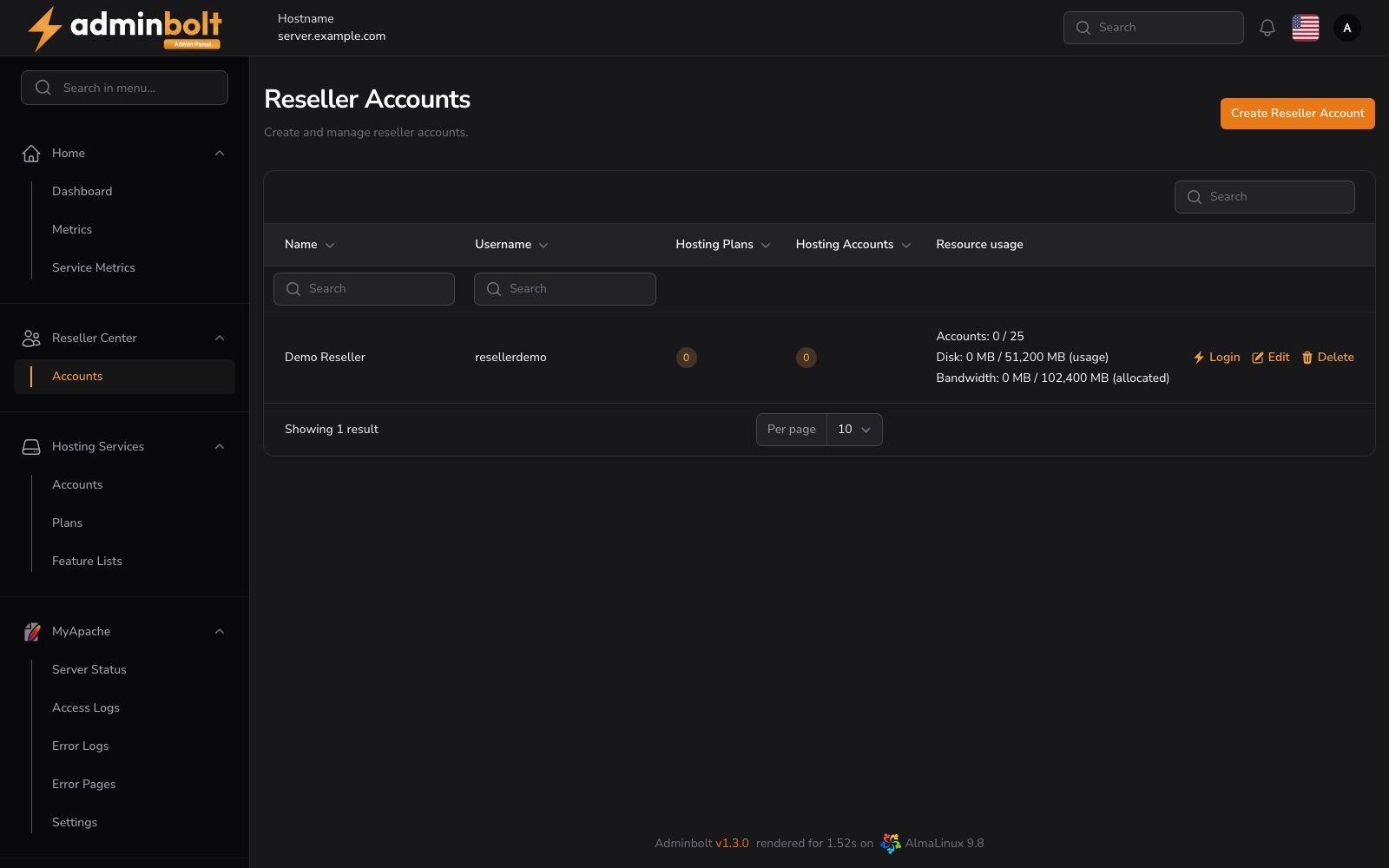
The Reseller Accounts section allows administrators to create, manage, and impersonate reseller accounts.
Overview
URL: /admin/resellers
This page displays a list of all reseller accounts along with the following columns:
- Name - Display name of the reseller
- Username - System username used for login
- Hosting Plans - Total number of hosting plans created by the reseller
- Hosting Accounts - Total number of hosting accounts managed by the reseller
- Resource usage - Current accounts, disk, and bandwidth usage against the reseller's limits (see Resource Limits)
Actions
- Login - Impersonates the reseller and opens their dashboard
- Edit - Update reseller info and credentials
- Delete - Permanently removes the reseller account
Search and Filtering
- Individual search boxes are available for:
- Name
- Username
Each input filters the list dynamically based on entered text.
Pagination
Pagination controls allow you to set how many records to display per page:
- Options: 5, 10, 25, 50, All
Creating a Reseller Account
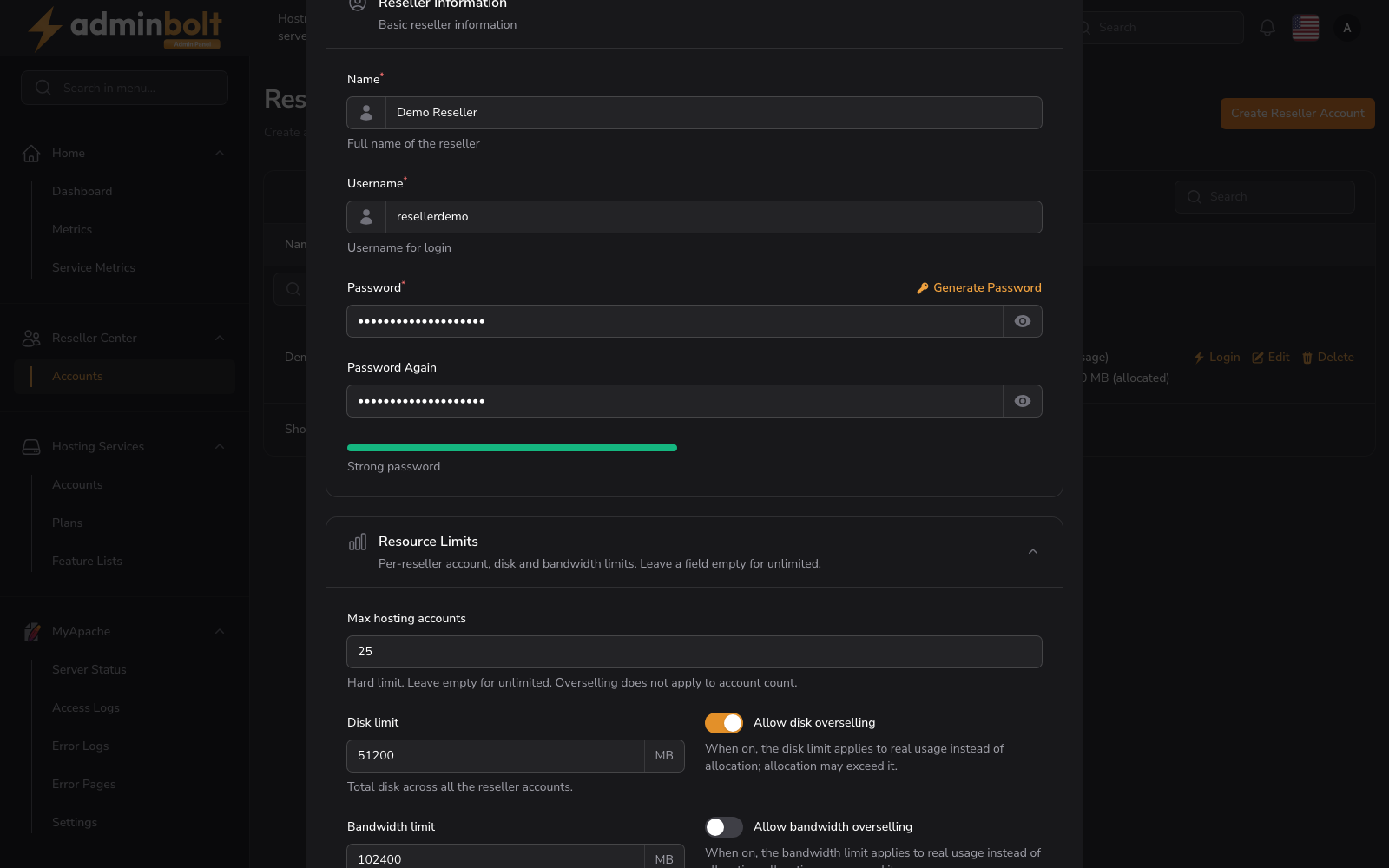
Clicking the Create Reseller Account button opens the creation form.
Fields
Reseller Information
- Name (required) - Full name for display
- Username (required) - Login username
- Password (required) - Secure password with strength validation
- Password Again (required) - Confirmation of password
You can click Generate password to auto-generate secure credentials.
Contact Details (optional)
- Email - Primary email address
- Phone - Contact number
Company Information (optional)
- Company - Business or organization name
Resource Limits (optional)
- Max hosting accounts - The maximum number of hosting accounts the reseller may own. Leave empty for unlimited.
- Disk limit (MB) - Helper text: Total disk across all the reseller accounts. Leave empty for unlimited.
- Allow disk overselling - When enabled, the disk limit applies to real usage instead of allocation; allocation may exceed it.
- Bandwidth limit (MB) - Monthly bandwidth cap. Helper text: Total monthly bandwidth across all the reseller accounts. Leave empty for unlimited.
- Allow bandwidth overselling - When enabled, the bandwidth limit applies to real usage instead of allocation; allocation may exceed it.
See Resource Limits for how allocation and overselling are counted and enforced.
Buttons available:
- Create - Save the new reseller
- Create & Create Another - Save and reopen the form
- Cancel - Close without saving
Resource Limits
Resource limits cap how much a reseller can hand out to their own hosting accounts. Every field is optional, and an empty field means unlimited.
- Max hosting accounts - A hard limit on the number of hosting accounts the reseller may own. Overselling does not apply to the account count: the reseller can never exceed this number.
- Disk limit (MB) - A cap on disk across all the reseller's accounts.
- Bandwidth limit (MB) - A cap on monthly bandwidth across all the reseller's accounts.
Allocation versus overselling
Each of the disk and bandwidth limits has its own Allow overselling toggle that changes how the limit is counted:
- Overselling off (allocation) - The limit is measured against allocation, which is the sum of the plan limits of the reseller's accounts. Because allocation is fixed at the plan level, a plan with an unlimited disk or bandwidth value is rejected when it would count toward a capped limit.
- Overselling on (real usage) - The limit is measured against real usage instead of allocation, so the total allocation may exceed the limit as long as actual consumption stays within it.
Enforcement
AdminBolt enforces these limits when a reseller creates a hosting account and when a reseller changes an account's plan, including requests made through the admin and reseller REST API. An action that would push the reseller past a limit is rejected, and the API returns a 422 response.
Resource usage column
The reseller list shows a Resource usage column summarizing each reseller against their limits:
- Accounts: X / Y - accounts owned versus the maximum.
- Disk: X MB / Y MB (usage) or (allocated) - the suffix is
(usage)when disk overselling is on, and(allocated)when it is off. - Bandwidth: X MB / Y MB (usage) or (allocated) - the suffix follows the bandwidth overselling toggle in the same way.
Notifications
AdminBolt checks reseller usage every 5 minutes and raises a notification when a reseller reaches or exceeds a limit. These notifications appear in the bell menu. Mail and webhook delivery are optional and driven by the matching notification templates.
Impersonating a Reseller
Clicking the Login button next to a reseller account allows the admin to impersonate that reseller.
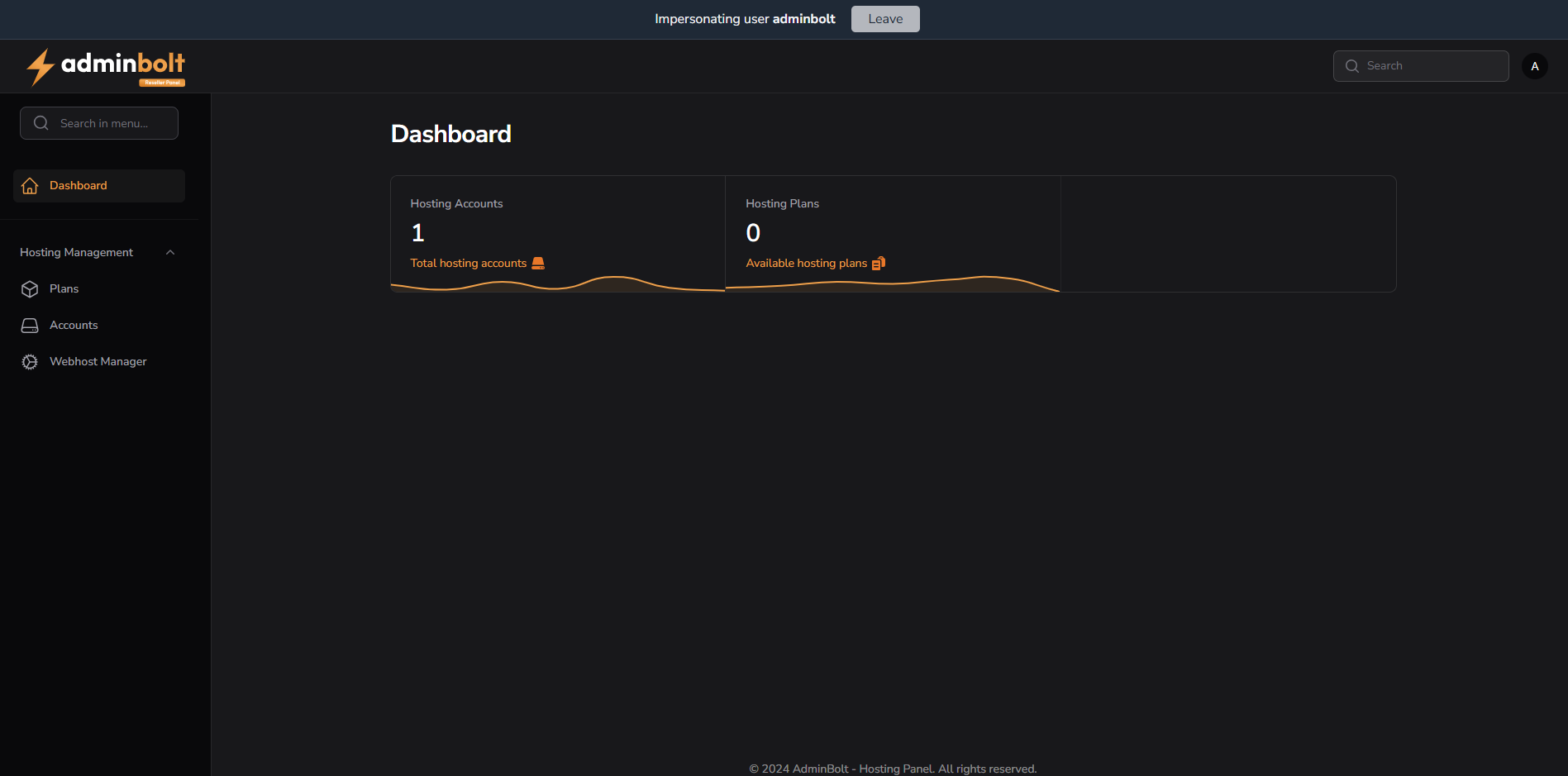
While impersonating:
- The top of the screen will display a blue bar with "Impersonating user {username}"
- The interface switches to the reseller panel layout
- To stop impersonating, click the Leave button in the top bar
Editing a Reseller Account
Clicking Edit opens the form with all fields pre-filled.
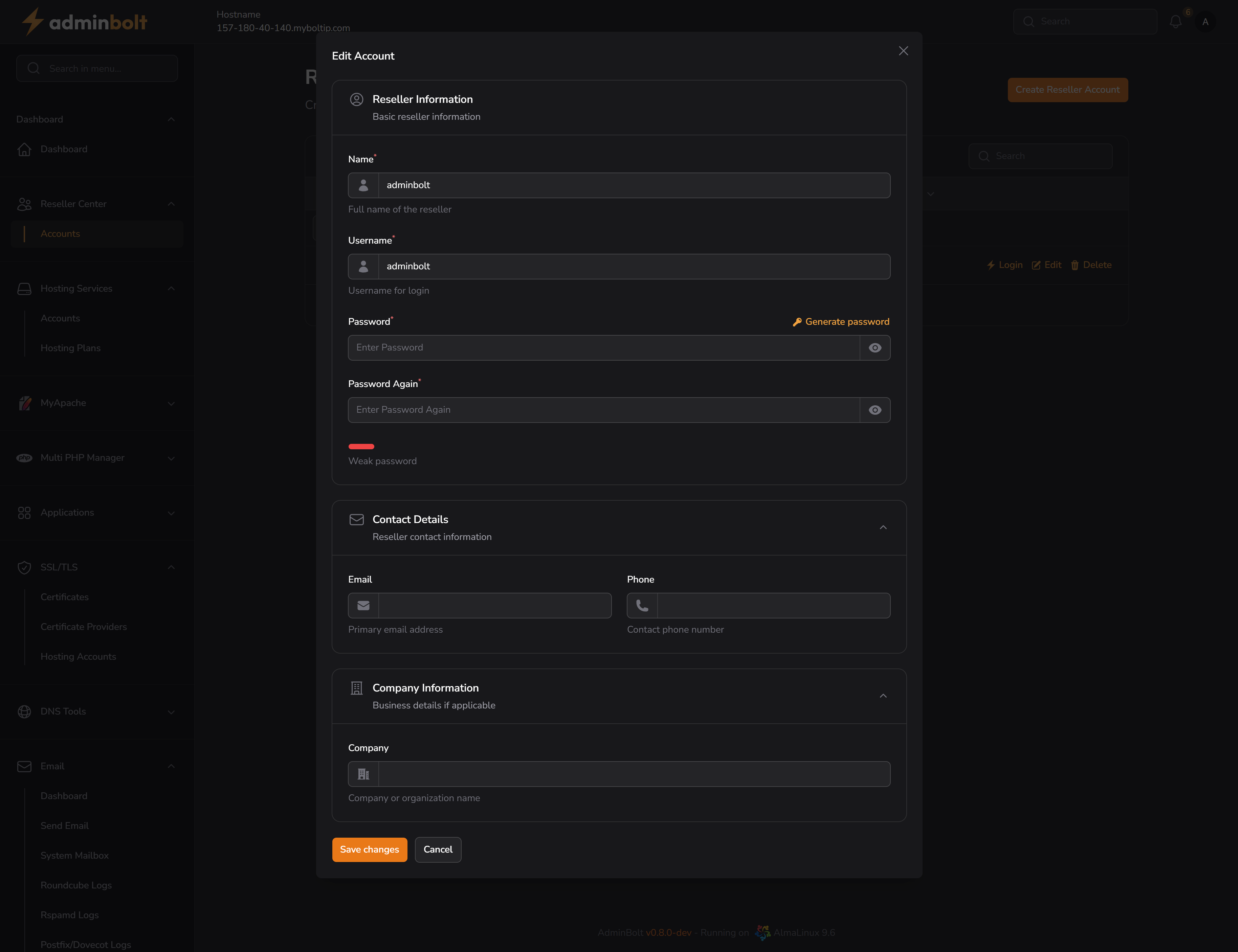
You can update:
- Name
- Username
- Password
- Contact and company details
Click Save changes to apply updates.